Atlantis Core is the reusable decision framework below options, perps, spot, scanners, dashboards, live trading, paper trading, replay, and research.
It turns adapter-normalized market state into evidence-rich trade theses, permission decisions, lifecycle objects, and outcome records. The framework deliberately avoids broker payloads, venue schemas, database rows, option strike lookup, and dashboard response models.
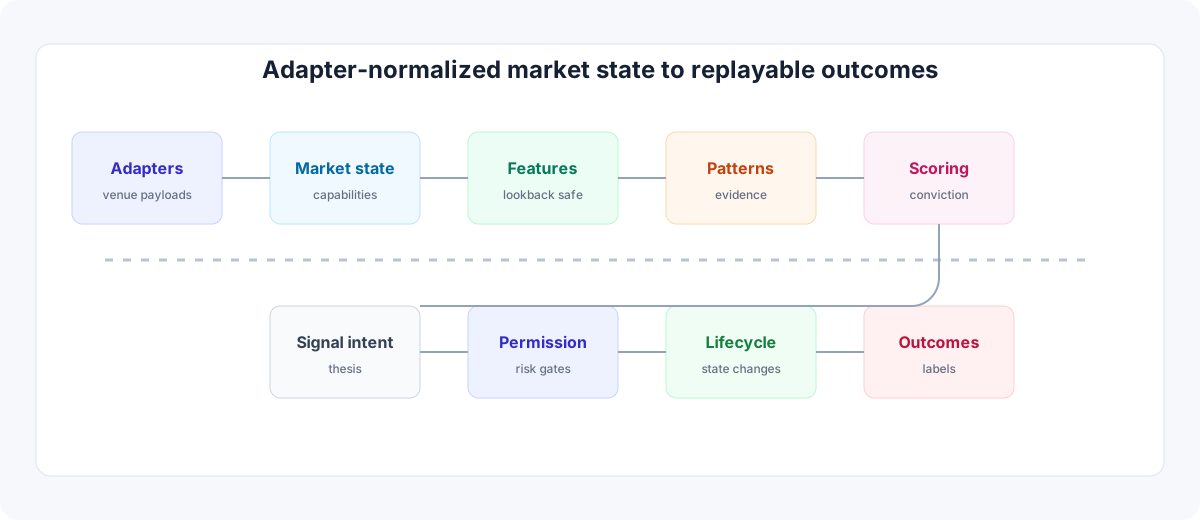
What We Built
The current repository implements the first instrument-agnostic vertical slice:
ReferenceTime
  -> EventEnvelope[]
  -> MarketSnapshot
  -> FeatureVector
  -> PatternHit[]
  -> TradeHypothesis
  -> SignalIntent
  -> PermissionDecision
  -> PositionIntent
  -> ExposureExpression
  -> OpenExposure
  -> MarkRecord / LifecycleTransition
  -> OutcomeRecord
The point is not to copy legacy Atlantis module-for-module. The point is to preserve its durable behavior while removing historical coupling to options, specific venues, process wiring, and TimescaleDB tables.
What Core Owns
| Area | Core object examples | Purpose |
|---|---|---|
| Time discipline | ReferenceTime, Clock, CycleContext | Make live, replay, and research use the same as-of semantics |
| Event ingestion boundary | EventEnvelope, EventLineage, AdapterEventBatch | Normalize adapter output without leaking raw venue payloads |
| Market state | MarketSnapshot, PriceCapability, VolumeCapability, OpenInterestCapability, GreeksCapability | Represent capability-bearing state with explicit availability |
| Feature extraction | FeatureDefinition, FeatureRegistry, FeatureVector | Compute deterministic features from bounded snapshots |
| Pattern detection | PatternDefinition, PatternStage, FeatureRange, PatternHit, PatternRegistry | Emit evidence, availability, version, stage, range score, and definition hash |
| Scoring | TradeHypothesis, EvidenceStack, ConvictionBreakdown | Aggregate pattern evidence into directional hypotheses |
| Signal intent | SignalIntent, ExposurePreference, IntentConstraints | Express the thesis without selecting an instrument contract |
| Permission | PermissionDecision, RiskContext, ReasonCode | Admit, reject, defer, or downgrade the intent with reason codes |
| Lifecycle | PositionIntent, OpenExposure, LifecycleTransition | Track state changes without broker orders |
| Outcomes | MarkRecord, CloseEvent, OutcomeRecord | Preserve path labels and economic labels separately |
What Core Does Not Own
Core does not own raw Delta, Zerodha, OpenAlgo, FastAPI, TimescaleDB, React, or broker order payloads.
Those belong in adapters or runtime layers:
- Venue adapters normalize market payloads into
EventEnvelope. - Instrument adapters express a
SignalIntentas spot, perp, future, option, or no viable expression. - Execution adapters place or simulate orders.
- Persistence adapters serialize core objects.
- UI adapters present views without reshaping the domain.
Why This Matters
Legacy Atlantis contains valuable behavior, but it was often embedded inside options-specific or runtime-specific code. The rewrite keeps the valuable parts and makes them portable:
- no hidden latest-row reads
- no wall-clock reads inside core logic
- missing, stale, invalid, and withheld data remain distinct
- signal generation is gate-free, while permission is reason-coded
- lifecycle states are append-only and replayable
- path outcomes and economic outcomes are separate labels
- tests encode behavior before migration changes land
Current Verification Standard
The current framework checkpoint is verified by:
python -m pytest
ruff check .
ruff format --check .
The suite includes contract tests, replay-safety tests, feature/window tests, pattern availability tests, scoring tests, signal intent tests, permission tests, lifecycle tests, adapter boundary tests, and the first legacy parity fixture.
The current verified count is 148 tests.
Reading Order
- Quickstart for the smallest working mental model.
- Time and events for replay safety.
- Market state for capability blocks and snapshots.
- Features and patterns for deterministic evidence.
- Scoring to permission for thesis and risk flow.
- Lifecycle and outcomes for state and labels.
- Adapters for where raw venue behavior enters and exits.
- Legacy parity for preserving old Atlantis lessons.
- Contract reference for a compact object map.